Threads of Blue by Suzanne LaFleur


Threads of Blue is the sequel to Beautiful Blue World, a story about children involved in an nameless war between fictional countries, a landscape that bears an uncanny resemblance to Europe. After being tested for their suitably, some children of Sofarende are sent away from their families to a remote area called Faetre as part of an Adolescent Army unit, where they worked on important intelligenc for the war effort. While in Faetre, the children were not allowed any contact with their families. 


You may recall that at the end of Beautiful Blue World, Mathilde Joss, 12, had committed what might be considered an act of treason that had caused her to become separated from the other members of her Adolescent Army unit as they are being evacuated to the safety of Eilean, an ally of Sofarende.


Now, Mathilde must try and find out where the Adolescent Army is on Eilean, after being brought across the sea that separates it from Sofarende. There is danger everywhere, even on Eliean, but Mathilde meets a kind family who takes her to a refugee camp to wait until she is eventually reunited with the other Sofarende kids and adults in her unit.


Once reunited with them, Mathilde waits to see if she will be punished for what she did before leaving Sofarende. And, even worse, her best friend Megs refuses to speak to her or even look at her for reasons Matilde can’t figure out, yet everyone else is as friendly as they had always been. Meanwhile, as Sofarende falls to the constant bombing of its enemy Tyssia, Mathilde works on maps to determine where their air force should drop their bombs in Sofarende in order to drive out the Tyssians.


While Mathilde tries to deal with some of the moral and ethical issues inherent in her war work and war in general, she must also come to terms with loss on several levels. Surprisingly, she gets help from an unexpected source, and moral support from others. All Mathilde really wants is to be best friends with Megs again, and to return to her beloved home and family. But then the horror of war, and the senseless killing and destruction that comes with it are brought home to Mathilde when she is sent to Sofarende on a secret mission. Will this young girl ever find the love and peace she craves?


If you haven’t read Beautiful Blue World, I would recommend doing so, but even if you don’t, you will have no problem reading Threads of Blue. There is enough explanation of the events from the first book embedded in this sequel so you won’t be lost.


The story is told from Mathilde's point of view, though experience has taken some of the innocence out of her stream-of-consciousness observations. She astutely describes life as a refugee living in a camp set up for Sofarenders fleeing their country as the war intensifies: the constant hunger, the inability to wash, the feelings of frustration everyone feels, all while mourning the loss of their country and loved ones. And when she returns to her homeland, she is stunned by the extent of ruin that the war had inflicted. In that respect, the images LaFleur word paints are particularly poignant and so, so very anti-war.   


Along that vein, look closely at the cover image of three children, two boys and a girl wearing a knapsack, who is obviously Mathilde, sitting in a row boat. They couldn't look more innocent, until you look more closely and see the faint shadows of bombs falling on them. This image says so much.


Like Beautiful Blue World, Threads of Blue is a brilliant novel about the ravages of war, but it is also a story about holding on to who you really are even when it causes you trouble, and facing life with bravado, honesty, and hope in a world where none seems to exist. These are two books not to be missed.


This book is recommended for readers age 9+

This book was purchased for my personal library.

The Librarian of Auschwitz by Antonio Iturbe, translated by Lilit Thwaites


In December 1943, Dita Adlerova, 14, along with her parents and 5,000 other Jewish prisoners arrived at Auschwitz-Birkenau from the Theresienstadt ghetto (also referred to as Terezín) in Czechoslovakia. Unlike most of the Jews who were transported to Auschwitz-Birkenau, this transport arrived with the notation SB - Sonderbehandlung. No one really knew what was meant by special treatment, but they were put into one of nine separate camps in Birkenau, called BIIb, and referred to as the Theresienstadt Family Camp. These prisoners were allowed to keep their clothing and their hair wasn’t shaved, although living conditions were just a deplorable as elsewhere in Auschwitz.


Thanks for Fredy Hirsch, the prisoner in charge of the children, Dita becomes an assistant in Block 31, a barracks that has been converted into a space for children during the day so that their parents can work. It is also a place that houses a secret school which includes a library of eight books that have been smuggled in by other prisoners and are in various states of disrepair. Dita’s job is to care for the books every day - removing them from their hiding place, delivering them to the teachers, and carefully putting them back into their hiding place. Dita takes her job so seriously, that when a surprise inspection that includes Dr. Josef Mengele happens, she risks everything to hide the books under her smock. 


But later that day, Dita runs into Mengele again,and she believes that he seems to know that she was hiding something that morning. He tells her he will be watching her from now on. His threat informs Dita’s life in Auschwitz with additional fear from then on, yet it doesn’t stop her from continuing her job as the librarian. 


The Librarian of Auschwitz is a powerful novel with a brilliant blending of fact and fiction. It is told mostly in the present tense, and I think the writing style may remind you of The Book Thief, especially the voice of the omniscient narrator who knows what has happened as well as what will happen. And I have to be honest and say it is a difficult book to read at times, but then, so are all books about the Holocaust.


Several of the characters are based on real people. Most of the Nazis in charge of Auschwitz, like Josef Mengele, the Doctor of Death, and Rudolf Höss, the camp commandant. The main character, Dita Adlerova, reflects the experiences of the real librarian of Auschwitz, Dita Polach Kraus, whom Iturbe interviewed in Israel when he was researching this novel. Iturbe also includes the stories of Fredy Hirsch, Rudi Rosenberg, and SS First Officer Viktor Pestek. Hirsch and Rosenberg were prisoners in Auschwitz, while Pestek was a guard who fell in love with a young Jewish girl. Other characters in the novel are strictly fictional, but whether real or fictional, each one contributes to the overall picture that Iturbe draws of this section of Auschwitz, an anomaly in what was a place where most people were sent to be killed upon arrival. 


And Dita's story is certainly an exemplary one. In the midst of so much heartbreak and horror, Dita derives a real sense of strength and purpose as the librarian, coming up with ways to improve the delivery of the fragile books to teachers, and carefully repairing them each day when they are returned. And, with the help of Fredy Hirsch, her sense of purpose develops into a way that Dita is able to cope with her own overwhelming fear, learning to accept it as part of who she is, and by recognizing it, she is able to overcome it and go on despite everything.


Thus, Iturbe’s draws Dita as a study of courage in the face of fear, and it becomes all the more poignant and admirable as she faces the horrors of Auschwitz, and later Bergen-Belsen. And while the actual atrocities that were endemic in the Nazi’s concentration camps and their treatment of Jews are difficult to fully capture in words alone, readers should know that Iturbe doesn’t hold back, that some of what he writes is quite graphic. 


Though fear, hunger, cold, death, cruelty, and loss of loved ones are the daily experiences of Dita and the other prisoners in Auschwitz and Bergen-Belsen, ultimately The Librarian of Auschwitz is a life-affirming novel that manages to end on a note of hope for the future.


A Teacher's Guide for The Librarian of Auschwitz is available from the publisher, Henry Holt and Co. (BYR) HERE


This book is recommended for readers age 13+

This book was an ARC received from the publisher


Map of Auschwitz II (Birkenau) showing Theresienstadt Family Camp BIIb and Block 31 where the secret school was held


Sunday Funnies #26: Archie Comics


I decided not to go to Comic Con this year, after standing on line to get in for almost 4 hours last year. But I’ve been thinking about comics this weekend anyway. I loved comics growing up and I like to feature some of the comics that were popular during the WWII. Comic are often such a measure of what is happening in the world.


And, sometimes, while reading a book for this blog, I come across things about WWII that I didn’t know and that take me by surprise. That’s exactly what happened while I was reading a mystery called The Girl is Murder by Kathryn Miller Haines. On page 36, the protagonist, Iris Anderson, 15, is reading an Archie comic book. Archie in 1942? The same Archie Andrews I read all those years later?


Archie was indeed a war-time creation, and Iris Anderson was probably reading Archie Comics #1, dated Winter 1942, on sale November 15, 1942, cost 10¢. But teenaged Archie’s first appearance, along with Jughead Jones and Betty Cooper, was actually a year earlier, in Pep Comics #22, dated Dec. 1941. It was a six page spread and introduced Archie as “America’s newest boyfriend.” 


Archie lived in Riverdale, along with his parents Mary and Fred Andrews, and attended Riverdale High School. Archie’s infamous jalopy was introduced in Pep Comics #25, dated March 1942 and the very rich Veronica Lodge, middle-class Betty Cooper’s rival for Archie’s affections, was introduced in Pep Comics #26, dated April 1942. More characters were added over the first year, including Mr. Weatherbee, the school principal. Mr. Lodge, who raison d’être was to keep Archie and Veronica apart, and Archie’s other friend, Reggie Mantle. It is interesting that there is no mention of the Archie story in either of these Pep Comics.


In 1942, with most of the characters in place, Archie got his own comic book, in which he was now billed as “The Mirth of a Nation.” The overall humor in Archie’s adventures is pretty much the same in these early comics and in the ones I read. And although he looked like a total doofus in the early Pep Comics and the first Archie Comics, his popularity continued to grow and his looks mellowed out somewhat. 


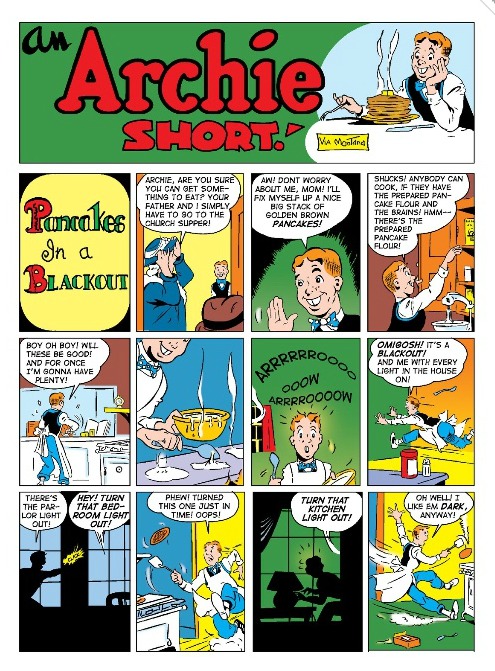
Oddly, even though the Pep Comics of the early 1940s had superheroes fighting Nazis, Archie stories were apolitical. It wasn’t until he had his own comic that the war began to figure into some, though not many, of the stories. The first one I found is called “Pancakes in a Blackout.” When his parents go out for the evening, Archie decides to make himself a nice stack of pancakes, but then the air raid siren sounds and he has every light in the house on. Well, see for yourself:


Archie has changed and evolved over time, but it's been fun revisiting those early days of Archie and the gang, and if you are like me, right about now you have "Sugar, Sugar" by The Archies running through your head. 


Among the Red Stars by Gwen C. Katz


Inspired by her hero Marina Raskova, Valka Koroleva, 18, wants nothing more than to fly for her country, the Soviet Union. Already a pilot, Valka’s first attempts to join the Red Army Air Force or VVS (Voyenno-Vozdushnye Sily) are initially turned down, but by September 1941, things have changed and they put out a call for qualified female pilots. 


And Valka is beside herself to learn that Marina Raskova will be in charge of the women pilots, and to be accepted into the initial training program Aviation Group 122 along with her cousin Iskra Koroleva, 21. 


Meanwhile, Valka’s childhood friend Pasha Danilin, 17, has been conscripted and is serving as a radioman in the Red Army. As enthusiastic as Valka is fight the fascists, Pasha is just the opposite. A sensitive person, who hears the sounds of the world in different colors, Pasha is just not cut out for war.


Valka’s cousin Iskra, with whom she is very close, is the daughter of “wreckers,” who were accused of sabotaging the 1937 census. They were arrested and imprisoned, and this fact follows and causes problems for Iskra, even in the VVS.  


The majority of the novel is focused on pilot Valka and navigator Iskra’s experiences on the ground and in the air, with a great deal of attention given to the sexism that the women pilots had to deal with while proving themselves to excellent aviators and brave fighters. Not that dropping bombs on enemies is done easily - Valka and Iskra are fully aware that they are taking lives.


Most of the action is told through an exchange of letters between Valka and Pasha, which also allows for orienting the reader timewise. Not only does the reader get a clear picture of what is going on, but they also get a lot of factual background information. This is one of those books that prompted me to look up people, places, and events that are included, to find out more. 


Katz also develops the feelings that Pasha and Valka have for each other, taking them from friendship to a deeper love. I hate to use the word romance here as some have,  because that might lead some readers to think this is a romance novel, when in reality it is excellent historical fiction with a romantic sub-story.


Among the Red Stars is a nice blend of fiction and reality. Through Valka and Iskra, Katz  traces the difficulties faced in creating the training Aviation Group 122 that later became the three regiments - the 586th, the 587th, and the 588th. Mixed among her fictional characters are some real heroic women aviators who fought and even lost their lives in WWII. And Katz does not hold back on some of her descriptions of the fighting - air and ground. 


Among the Red Stars is an exciting debut novel, occasionally bogged down by the descriptions, but otherwise very well worth reading, especially if you like historical fiction, or have an interest in WWII history, women’s history, aviation. Katz includes more information about Aviation Group 122 and the fate of some of the Russian women who flew in WWII.


FYI: the success of the Russian women aviators of the 588th Night Bomber Regiment, in which Valka and Iskra serve, earned them the name Nachthexen or Night Witches by the Germans.  


Pair this with Flygirl by Sherrie L. Smith and Code Name Verity by Elizabeth Wein for an interesting comparison of fictional representations of female pilot experiences in WWII. 


For anyone interested in more information about the women who flew for the Soviet Union in WWII, these two were recommended by Gwen Katz, author of Among the Red Stars. They are A Dance with Death: Soviet Airwomen in WWII by Anne Noggle, published by Texas A&M University Press, 1994, 2007; and Wings, Women, and War: Soviet Airwomen in World War II Combat by Reina Pennington, University Press of Kansas, 2007. 


This book is recommended for readers age 13+

This book was a ARC provided by the author


This is the kind of plane the 588th flew in the nightly bombings.

It was made of canvas and wood

Source: By Douzeff - Own work, CC BY-SA 3.0 


Dazzle Ships: World War I and the Art of Confusion by Chris Barton, illustrated by Victo Ngai


During WWI, the Germans had a real advantage over their enemies, Britain and the United States. They had perfected the use of submarines from which they could launch torpedoes, making their enemies ships literal sitting ducks. Britain was especially desperate to find a solution to the sinking of ships, both military and non-military, since, as an island, they relied on boats to bring them much of what they needed, especially food, and so far, nothing has worked.


That is, until Norman Wilkinson, a lieutenant-commander in the Royal Naval Volunteer Reserve, came up with an unlikely idea - camouflage the ships. 


But how do you camouflage a huge ship? Wilkinson knew you couldn’t make a ship invisible, but they could be painted so that they confused submarine officers trying to figure out which way and how fast the ship in their sights was traveling.


The idea of camouflage was nothing knew, but Wilkinson suggested painting a crazy pattern on one side of a ship and another crazy pattern on the other side. The patterns used were called dazzle and amazingly enough, it seemed to work. Pretty soon, two dozen women artists were creating dazzle patterns that were then applied to ships by painters and artists working together.


Did dazzle camouflage save any ships from being torpedoed? The British painted 3,000 ships, the Americans painted 1,000, but in fact, there may have been too many other factors making it hard to determine how effective the dazzle ships really were.


In this well-written chronicle about the Dazzle Ships of WWI, readers will be intrigued that such a far-fetched idea was accepted and carried out (even the King of England was dazzled by the ships). Barton’s text is enhanced and supported by Victo Ngai’s dynamic analog and digital media illustrations, which reflect not just the patterns of the dazzle ships but are rendered in the style and colors of the early 20th century, especially the art movement known as cubism.   


Dazzle Ships is a picture book for older readers is sure to appeal to anyone interested in the history of WWI and no doubt they will find this creative problem solving to a serious problem both fascinating and inspirational.


A WWI timeline is included that shows just how dazzle ships fit into the events of the war. And be sure to read the Author’s Note and the Illustrator’s Note for more information.


FYI: Author Chris Barton has contributed a very informative guest post at The Lerner Blog in which he writes about why he wrote Dazzle Ships. 


This book is recommended for readers age 7+

This book was purchased for my personal library


Example of a Dazzle Ship: HMS Kildangan 1918 (Public Domain)


Cover Reveal: Brave by Jennifer L. Armentrout (Announcement + Giveaway)

Title: Brave
Author: Jennifer L. Armentrout
Series: A Wicked Saga, #3
Publication Date: December 11, 2017

Synopsis: Ivy Morgan hasn't been feeling like herself lately. Not like anyone can blame her. After all, being held captive by a psychotic fae prince hell-bent on permanently opening the gates to the Otherworld is bound to leave some mental scars.

It’s more than that, though. Something dark and insidious is spreading throughout Ivy, more powerful than she could ever imagine... and it’s coming between her and the man she’s fallen deeply in love with, elite Order member Ren Owens.

Ren would do anything to keep Ivy safe. Anything. But when he makes a life altering choice for her, the fallout of his act has far reaching consequences that threaten to tear their lives apart. If Ivy is going to have any hope of surviving this, she must put aside the hurt and betrayal she feels, and work with not only those she loves, but with an enemy she would rather kill than ever trust. War is coming, and it soon becomes clear that what Ivy and Ren thought they knew about the Order, themselves, and even their enemies, has been nothing but a cluster of dangerous, deadly lies. Ivy knows she must be more than just brave to save those she loves--and, ultimately, to save herself.

Because behind ever evil fae Prince, there’s a Queen…

About the Author: # 1 NEW YORK TIMES Bestselling author Jennifer lives in Martinsburg, West Virginia. All the rumors you’ve heard about her state aren’t true. When she’s not hard at work writing. She spends her time reading, working out, watching really bad zombie movies, pretending to write, and hanging out with her husband and her Jack Russell Loki.


AND NOW, for the beautiful cover....


Announcement:

To celebrate the upcoming release of BRAVE (book 3 in the Wicked Saga), Jennifer is offering an exclusive virtual signing! Through this virtual signing, you will be able to order SIGNED & PERSONALIZED copies of WICKED, TORN, and BRAVE! 

And best of all -- This is OPEN INTERNATIONALLY! 

The Virtual Signing opens on 9/21/17 at 11 am ET & ends on 11/17/17.


Giveaway:

a Rafflecopter giveaway

-Kristen ♥

Blog Tour: Mari's Hope by Sandy Brehl


Mari’s Hope is the third book in the Odin’s Promise Trilogy. In the first book, In Odin’s Promise, Mari is only 11 when the Nazi’s invade her beloved Norway on April 9, 1941. Life as she knew changes overnight, and slowly, she learns that the Norwegians in her village and all over Norway are not taking the invasion and occupying German solders lying down - an active and successful resistance springs up almost immediately and by the end of the novel, after suffering a heartbreaking loss, Mari herself is part of the resistance.


Book Two, Bjorn’s Gift, begins in August 1941. When German officers move into their home, Mari's family move in with her grandmother in order to continue their resistance work, even risking sheltering refugees in the attic. Bjorn is away, now a full time part of the resistance, and Mari decides to secretly record everything that is happening at home for him to read after the war. Mari is also disappointed when she learns her old friend Leif and his family seem to have become collaborators.  


Mari’s Hope begins in February 1943. Mari is now 14 years old and while still part of the resistance, she has also become a highly regarded assistant to Dr. Olsen, often visiting the sick in their  isolated homes spread out on the mountainside around her village of Ytre Arna. Food, fuel to heat homes, and a shortage of medical supplies have caused major problems for the folks who refuse to help the Nazis, including Mari’s family. 


Mari is also able to travel to Bergen, to visit her sister Lise, a nurse, and to take her examinations to become a health aide. There, she meets Hanna, a smart, lively, not easily scared 8 year-old, and her friend Rolf, 14. But on her second meeting with Rolf, Mari and Hanna find him suffering serious injuries after some Norwegian Hitler Youth beat him up, and Mari ends up performing resistance tasks for him in Bergen before returning home. 


Mari soon finds herself traveling again to Bergen. This time it is to try to get some needed medical supplies, using a clever ruse concocted by Dr. Olsen and a friend of his in Bergen. She goes a third time to Bergen to try to help out after a harbor explosion destroys much of the area in April 1944, and  to find Hanna and her older sister Julia, fearing that they may have perished in the intense fires.


At home, Mari is still having difficulties with her old friend Leif and his collaboration with the Nazis, and of course, there is still the despised German officer Klein, whom Mari had nicknamed Goatman in Odin’s Promise, an alcoholic who is known for his excellent ability to trace illegal radios, one of which is owned by Mari's family.


Brehl’s realistic depiction of life under the Nazis, of the way spontaneous resistance groups formed, of the fears, the deprivations, and even some of the happy times is probably the strongest appeal the Odin’s Promise Trilogy has for me. Authenticity in historical fiction is important, and I felt that Brehl had really nailed it, and yes, the terrible explosion in Bergen really did happen. 


One of the other things I really liked about each book in the Trilogy is the consistent message that each of us can make a difference under difficult circumstances if we work together, and Mari’s family is the perfect example of that idea. Resistance is a theme that really means a lot to me and I found the large and small acts in Odin’s Promise, Bjorn’s Gift, and Mari’s Hope gave me some hope that something as odious as the Third Reich can be overcome. 


Mari’s Hope takes the reader up to and just beyond the end of the war, and while there is some heartbreak in this novel, there are some nice surprises as well. And Brehl ties things up with a satisfying conclusion so there are no hanging ends. Much to her credit for creating such appealing, realistic characters, I did find that I was somewhat sad to close the book at the end of Mari’s Hope after traveling along on her wartime journey these past few years. 


The Odin’s Promise Trilogy are three books that will appeal to anyone interested in WWII, the Norwegian resistance, and themes about family, friends, and life on the home-front in a war.


This book is recommended for readers age 9+


This book was an ARC received from the author


About the Author: Sandy Brehl is the award-winning author of a Norway historical trilogy for ages ten-thru-adult. (ODIN’S PROMISE, BJORN’S GIFT, and MARI’S HOPE) She also writes a blog about picture books (http://Unpackingpicturebookpower.blogspot.com) and contributes to a blog about historical works from middle grade readers (https://thestoriedpast.org). She’s an active member and volunteer with SCBWI-Wisconsin. Sandy writes fiction, nonfiction, and poetry for young readers of any age. A retired educator living in the Milwaukee area, Sandy offers programs for schools, libraries, and adult groups. 


Learn more at www.SandyBrehl.com 


                   Follow on Twitter @SandyBrehl and @PBWorkshop

                                     Facebook: Sandy Brehl Author


Be sure to visit the other stops on the Mari’s Hope Blog Tour:


9/6/Rosemary Kiladitis - Mom Read It


9/7 Trisha Perry - Mindjacked


9/11 Jenni Enzor - Jenni Enzor


9/12 Stephanie Lowden - Golowd


9/18 Suzanne Warr - Tales from the Raven