Hiển thị các bài đăng có nhãn Picture Book for Older Readers. Hiển thị tất cả bài đăng

A Scarf for Keiko by Ann Malaspina, illustrated by Merrilee Liddiard


A Scarf for Keiko by Ann Malaspina,


illustrated by Merrilee Liddiard


Kar-Ben Publishing, 2019, 32 pages


Ever since President Roosevelt had declared war on Japan on December 7, 1941, the kids in Sam's class have stopped talking to the Japanese American kids at school. Now, Sam's whole class are learning to knit so they can make scarves and socks for the soldiers who are fighting in the war, including Sam's older brother.


But Sam hates knitting and he isn't very good at it, unlike Keiko Saito, whom he's know for years and who sits next to him in school and is a great knitter. But whenever she offers to help him, he refuses. In fact, Sam now refuses to have anything to do with Keiko, even after witnessing her being harassed by a teenager as she rode her bike home from school.


But when Sam's mom sends him to the flower shop for some flowers for Shabbat, he sees that Mr. Saito's grocery has been vandalized and Go Back to Japan is written on the closed flower shop. During the Shabbat meal, Sam's dad tells him and him mom that President Roosevelt has decided going to send people of Japanese ancestry away, fearing they might be spies for Japan.


On Monday, Keiko isn't in school, but Sam sees her after school, knitting in front of her house. At home, Sam's mom tells him the Saito have to pack and leave soon, taking only what they can carry and she has volunteered to care for Mrs. Saito's lovely tea set. On the morning after the Saitos have left, Sam finds Keiko's bike in front of his house with a note for him to use it while she's away and a pair of hand knit socks for his brother Mike.


Thinking that Keiko will be cold where she is in the desert, Sam is determined to learn how to knit something to send her: a lovely red scarf to keep her warm.


A Scarf for Keiko is a great story about tolerance and how easy it is to be swayed by friends into turning on good neighbors and friends because they are being portrayed as being un-American simply for being who they are. It also shows how conflicted Sam is about no longer being friends with Keiko, whose family has been such good neighbors with his family, and the way his brother Mike helped Keiko fix her bike, and then not speaking up when he sees injustice all around him. He conflict is increased when his mother reminds the family that her sisters in Poland are in danger because they are Jewish and that Mike is in danger as a soldier.


The simple illustrations add much to the story and are done in a muted palette of blues, browns, greys, and touches of red that give a retro feeling. Faces are a bit exaggerated so that they reflect the wide spectrum of character's emotions - fear, conflict, worry, sadness, hate, kindness, even happiness.


A Scarf for Keiko is a great picture book for older readers who may be old enough to have witnessed acts of intolerance in today's world and are also conflicted about what is happening.   


Back matter includes an Author's Note that explains why and how people of Japanese ancestry, including Japanese Americans like Keiko and her family, were put in internment camps by President Roosevelt's Executive Order 9066. I need to mention that there is a typo here, stating the date of the Japanese attack on Pearl Harbor as December 6, 1941, when in reality it was December 7, 1941. Other than that typo, this is an excellent book to share with young readers.


Teachers and students can find a useful downloadable Activity Guide for this book HERE


This book is recommended for readers age 7+

This book was borrowed from the NYPL

Soldier for Equality: José de la Luz Sáenz and the Great War written and illustrated by Duncan Tonatiuh


It's not often enough that I get to read and report on books written about Mexicans and/or Mexican Americans in WWI and WWII, but it's not for a lack of heroes, rather it is for a lack of books written about them for kids and teens. So I was really happy to see that Duncan Tonatiuh, one of my favorite Mexican American writers, has written a wonderful new picture book for older readers that is a such an important contribution to the history of Mexican Americans in this country.


Despite being born in the United States, José de la Sáenz and other people of Mexican origin (Tejanos) living in Texas were often harassed and mistreated. They were people who did as much and sometimes more work than the white Texans, but were still treated like second-class citizens. They were prohibited from entering business with signs reading NO MEXICANS ALLOWED, and children were sent to schools that were segregated, small, cramped and ill-equipped. José was proud of his Latinx roots and worked hard, graduating college and becoming a teacher.


Click to enlarge

When the United States entered WWI in 1917, José and other Mexican American men did not hesitate to enlist to defend their country, a country they loved. José was sent to boot camp in Oklahoma, where he and others were still mistreated by their white officers. These were the soldiers who formed the 360th Regiment of the 90the Division of the US Army.


Finally, in June 1918, José and the other soldier left for the war in Europe, arriving in France shortly after. There, José began to study French, relatively easy for him given the similarities it has with Spanish. Because of his quick language skills, José worked in communications in a protected command post instead of fighting in the trenches. In fact, the war ended just before he was finally sent to fight in a attack that José knew would mean the death of thousands of American soldiers.


Click to enlarge

Back in the States, José began to organize the Mexican American soldiers of the 360th to socialize and talk about their experiences. That led to an idea to form organization that would fight for the rights of all Tejanos. But back home in Texas, José noticed nothing had changed. It was time for José and all Mexican American veterans together with other Tejano other civil rights leaders time to organize.  Finally, in 1929, the League of United Latin American Citizens (LULAC) was formed. José remained a member of LULAC, fighting to end racism, prejudice and school segregation, and for equality and justice for all Latinx.


The life and work of José de la Sáenz is certainly inspiring and, might I add, timely. As usual, Tonatiuh has really done some careful research on his subject, using the diaries that José kept over his lifetime to the best advantage in this new work. To give it a feeling of authenticity, simple Spanish phrases like No es justo are included throughout the book, but require no previous knowledge of Spanish, since like French, there is enough Latin in English to understand them. But, because Tonatiuh is a thorough writer, there is a Glossary included in the back matter. Also included in the back matter are references to the quotes and paraphrases from José's diaries that are used in the text, an important Author's Note, a Timeline of WWI and José's involvement, as well as a Timeline of the League of United Latin American Citizens, and a Select Bibliography.


Tonatiuh's flat, geometic hand drawn illustrations are done in a palette of dark earth-tones, then digitally collaged, and are done in the same style as his other books. This style is based on the Pre-Columbian 15th century art of the Mixtecs, an indigenous group from Southern Mexico, and Tonatiuh has been using it ever since to foster a sense of pride in Mexican culture for his readers.


This is a wonderful book for anyone interested in WWI and/or Latinx history and I highly recommend it. It would be an especially nice book to share with students for Veterans Day which is coming up on November 11, 2019.


You might want to pair this with other Mexican wartime heroes found in The School the Aztec Eagles Built: A Tribute to Mexico's World War II Air Fighters by Dorinda Makanaõnalani


You can find out more about Duncan Tonatiuh and his art on his website HERE


You can read an article with more information on José de la Sáenz and the 360th Regiment in France HERE


This book is recommended for readers age 7+

This book was purchased for my personal library

The Brave Cyclist: The True Story of a Holocaust Hero by Amalia Hoffman, illustrated by Chiara Fedele


Sometimes the most unlikely people find themselves in a situation that calls for action and bravery and they rise to the occasion. This is certainly the case of Tour de France champion Gino Bartali.


Born in Florence, Italy, Gino was a small, sickly boy who found release riding a bike, even if it was a rusty second hand bike. Before long, he could outrace his friends, even those with better bikes. In sixth grade, Gino decided to learn more about cycling, and got a part-time job with Oscar Casamanti, a man who repaired racing bikes. When he was invited to ride along with some racers through the Tuscan hills, Gino persevered even as some riders dropped out. Casamanti was so impressed, he recommended Gino take part in professional races.


At 17, he began training and racing more, and by age 21, Gino had become a powerful, winning racer. In 1938, he participated in the Tour de France and despite having an accident during the race, he still managed to win. By now, Benito Mussolini had declared himself Il Duce, the leader of Italy and a ally of Adolf Hitler. Mussolini declared Jewish citizens to be enemies of the state. Kids could no longer go to public school, or play in public parks, and their parents lost their jobs. Many Jews were arrested.


Then, in 1943, Gino received a mysterious telephone call from the archbishop of Florence, Cardinal Elia Dalla Costa. Could Gino help them? Riding his bike, Gino became a secret courier for the cardinal - making a 110-mile trip to deliver papers, photographs, and identification papers to a printer in Assisi, Italy, who then created forged identification papers that would be give to Jews in the hope that the papers would save their lives.


Gino carried on this important work until he was arrested in 1944, accused of selling guns to Mussolini's enemies. Released after 3 days, Gino went into hiding for a few months, until August 1, 1944 when the war ended in Italy and Italians were freed from Mussolini's grip.


And Gino? He went back to training for bike races, even winning the 1948 Tour de France again.


The Brave Cyclist is such an important story, and yet, one very few people knew about until now. Gino's story is a particularly important one when you realize that the punishment for helping Jews in any capacity was death, and not just for the helper, but often for their family as well. But Gino's story is also an inspiring one that proves the even one person can make a difference, that resistance can change people's fate. And the whole time Gino rode his bike great distances, often being stopped and searched by soldiers, delivering documents to be converted into forged identification papers, he had to keep his activities to himself. He could not even tell his wife so that if they were arrested, she wouldn't know anything.


In addition to an accessible written biography, Chiara Fedele's affecting illustrations are done in bright hues reflecting the happy days of cycling and racing, then switch to mostly dark hues reflecting the dark times of Mussolini's reign, complimenting and enhancing the text.


This is one of my favor illustrations. Gino has just been stopped and searched by soldiers,
now he's riding into the open field of the countryside, bringing freedom to some of Italy's Jewish citizens.

The Brave Cyclist is a picture book for older readers that is sure to generate some wonderful discussions among young readers about what they might do if they found themselves in the same circumstances as Gino.     


Author Amalia Hoffman has included an Afterword that goes into detail about Gino Bartali's life, and his heroic actions. In fact, she writes, that Gino was recognized as a Righteous Among the Nations by Yad Vashem in Israel, and what greater honor can there be but to be so acknowledged. You will also find an important Select Bibliography in the back matter for further investigation.


This book is recommended for readers age 8+

This book was provided to me by the publisher, Capstone Editions

War is Over by David Almond, illustrated by David Litchfield


David Almond has always been one of my favorite authors, so when I saw that he had written a book commemorating the centennial anniversary of the end of World War I, I knew I had to read it. If you are already familiar with Almond's books, you know they are always tinged with a bit of magic mixed into his spot on depictions of time and place, and characters who are just trying to make sense of the world around them. And so it is with this novella.


How, young John and his classmates want to know, can they be at war with the Germans, they're only children. It's 1918 and all John has ever known is the world at war. His father has been fighting in the trenches in France for so long, John barely remembers him. And his mam has been working 12 to 24 hours a day in the world's largest munitions factory near their home, making ships, and bombs, guns and shells. John worries about both his parents - his dad getting killed at the front, his mam in a accident at the munitions factory, and he just wants to know when the war will be over. First, he asked the king in a letter, but never heard back from him; next he wrote the Archbishop of Canterbury, who likewise didn't respond. There were not answers at school, either.


Then, on a class trip to the munitions factory, John sees a man speaking out against the war, telling them that children are not at war, and them showing pictures of German children, children who look  just like they do. The man, Gordon, is a conscientious objector, or conchie, and is beaten by three men, but not before John rescues a picture of a German boy named Jan.


John tries to write to Jan, but oddly enough, he runs into Jan in the woods near his home after having spent some time with Gordon, who gives him his white feather, considered to be a symbol of cowardice. John and Jan are just alike, and both agree that they are not at war with each other. But, just as suddenly as he appeared, Jan is gone.


Desperate for peace after his meeting Jan, John begins to dream of a time when there would be peace, when everyone could be friends again. And when peace finally does come, John determines that he will go to Germany and become friends with Jan someday.


War is Over is a powerful anti-war novella about a child confronting the horrors of war on the home front and expressing the kind of confusion about what he sees and hears that you would expect from a child. John's teacher's extreme jingoism is really evident in the militarist way he treats people, including his class, and his nationalist ideas, especially his contempt for Gordon, the conscientious objector. You can really the sense the contempt he feels for John, treating him as though he is a conchie-in-training. In fact, everyone, including John's mother, is afraid to be seen as unpatriotic. When John's letter to Jan is confiscated by the authorities, she almost turns her back on her own son.


Almond doesn't glorify or celebrate war and David Litchfield's black and white illustrations support that throughout the book. Though they are done in a cartoon-like style, they are no less poignant as they still capture all the horror of war in the trenches and on the home front in a town that supports war. I think one of the most effective illustrations shows the transition for children playing war into soldiers fighting at the front. This image is from Litchfield's website but I decided to use it instead of the black and white image in the book so you can see the transition more clearly, not just of the children, but of the falling leaves becoming dropped bombs:


War is Over is a powerful book that tackles some difficult themes that are as relevant today as they were in 1918. Jingoism, nationalism, patriotism, cowardice, bravery, the impact of war on children and families are all addressed as John observes the world around him. This is a heartbreaking, yet hopeful story, one you won't soon forget. Pair this with Captain Rosalie by Timothée de Fombelle for another view of how war impacts children.


This book is recommended for readers age 9+

This book was purchased for my personal library


Listen to David Almond talk about and read from War is Over:


The Good Son: A Story From the First World War Told in Miniature by Pierre-Jacques Ober, illustrated by Jules Ober and Felicity Coonan


The Good Son is probably the most unusual book I've reviewed on this blog. It is a World War I story about one small soldier's experience and although it's a picture book for older readers, the recommended is age 14+. And it isn't exactly illustrated in the traditional sense - each page is photographed using customized painted miniature figures, more sophisticated versions of the kind toy solders so many kids played with, and all of them are set in detailed landscapes, creating powerfully effective tableaus.


Written one hundred years after the end of WWI, the tale opens, in slightly blurred black and white photos, long after the war is over.  It was a war that was supposed to be over by the first Christmas, but instead went on for years, while people suffered and kept going into battle.


"About one hundred years ago, the whole world went to war"

The story shifts then to color photos of Pierre, a young French solder, sitting alone, locked in a barn. Pierre is facing execution for desertion, having gone AWOL for two days to spend Christmas with his widowed mother and not wanting her to be alone. Left by himself in the barn, Pierre has time to think about why he enlisted, about loyalty, about the horrors of war, and about what had been his hopes and dreams for his life after the war.


Believing the propaganda and wanting to make his mother proud, Pierre had, like so many men, signed up to fight once war was declared in 1914. As the war drags on, and more and more men are killed, Pierre realizes that war is terrible, a point that is made over and over. But, Pierre was a good soldier, even receiving a commendation for capturing six German soldiers, albeit, soldiers who are tired of war and just want to be out of it - feelings Pierre shares with them.


Readers learn a lot about Pierre as he sits in the barn awaiting his fate. His friend Gilbert, who once saved Pierre's life, brings him in food, wine, and company. But even Pierre's good behavior and  commendation don't help him when his colonel sentences him to be shot for desertion the next morning:


As the war drags on, and morale sinks among the other soldiers, the colonel had decided to make an example of Pierre.


So, no, Pierre doesn't not survive the war but his story is sure to remain with sensitive readers long after they close this book.


The Good Son is probably one of the most effective anti-war books I've ever read. Pierre's story is told in one or two short lyrical sentences on each page, with accompanying photos that move the tale along, revealing the pointlessness and the unfairness of war. Readers will find themselves asking questions about how propaganda is used to motivate people, especially young people, about patriotism, and about how does a good son, a good soldier end up in front of a firing squad? All this makes The Good Son is a very interesting and unusual philosophical look at war.


An compelling point that this book makes is that war is fought by little solders, young men like Pierre, and that these soldiers are at the mercy not only of the military, but also the politicians who decide to go to war, a point the is driven home through the metaphorical use of little toy soldiers, making Pierre's story all the more poignant. And I think that the little toy soldiers have a much more profound impact on the reader that conventional illustrations would have had.


You may have a hard time getting your teens into this picture book, but I believe that once they begin to think and explore its pages, The Good Son will really resonate with them. After all, some of them may be the future's little soldiers.


Back matter includes A Note from the Author and photographs and an explanation on The Process by which The Good Son was created. You can also find would some photographs of how each tableau was created on the author's Instagram page.


Parents and teachers can also find factual information giving context for The Good Son HERE


The Good Son will be available in the US on May 14, 2019.


This book is recommended for readers age 14+

This book was sent to me by the publisher, Candlewick Studio


Fish for Jimmy: Inspired by One Family's Experience in a Japanese American Internment Camp written and illustrated by Katie Yamasaki


When people of Japanese descent were rounded up and sent to live in internment camps shortly after the United States entered World War II, they found themselves eating a very different diet than the fresh fish, vegetables, and fruit that had been available when they had lived near the Pacific Ocean. Jimmy and his older brother Taro are no exception to enjoying fresh food, after all their parents own a Farmer's Market.


But early in December, after the attack on Pearl Harbor, their father is taken away by three men in the FBI. The family can no longer live in their home and run their Farmer's Market, and Jimmy, Taro and their mother find themselves "forced to live in tiny barracks surrounded by guards." Confused about what is happening, Jimmy refuses to eat the unfamiliar food he is served.


And no matter how much they try to coax him, no one can get Jimmy to eat. Although everyone is worried about him, Jimmy just doesn't understand why his family isn't living in their home near the ocean. Or why they can't eat his mother's good rice and noodles, or the fresh vegetables and fish he loves so much? Soon, Jimmy even stops playing with the other kids.


One night, Taro, worried about Jimmy and feeling responsible for taking care of him in their father's absence, makes a big decision. Taking a borrowed pair of garden shears, he quietly leaves the barrack, find a place in the fence where the guards can't see him and clips a hole he can crawl through.


Finding a mountain stream, Taro waits until he feels a fish hitting against his leg, then quickly grabs fish after fish, wrapping them in his mother's scarf. And in the morning, there is fish for Jimmy, who finally eats to his mother and Taro's relief.


In her end note, author Katie Yamasaki writes that Fish for Jimmy is based on a true story from her family's history. Her great-grandfather was arrested by the FBI just as Taro and Jimmy's father had been, though it was her grandfather's cousin who snuck out of the camp to find fish for his young son. I think that by putting the stories together, Yamasaki is able to highlight the impact that interning innocent people, particularly children, based solely on their ethnicity through Jimmy's depression and his refusal to eat and works to make this a very accessible story for young readers. Sadly, it made me think about all the Jimmys who found themselves in these camps and who were too young to understand what was happening.


The illustrations, done with acrylic paint, vividly capture the emotions each person is feeling. The reader sees Jimmy going from a happy little boy to a depressed child and finally as a smiling kid after having a taste of home again. The danger Taro faced sneaking out to catch the fish is aptly shown in a spread with the barbed wire fence in the foreground and guards with big guns in the background, and behind that, readers can see Taro's searching for the right spot in the fence to cut through. It is a wonderful, dynamic, rather sophisticated image, and Yamasaki the muralist painter is really present in it.


Fish for Jimmy is an excellent choice for introducing the history of the internment of Japanese Americans to young readers and it will definitely resonate with things happening in today's world for them.


This book is recommended for readers age 6+

This book was borrowed from the Bank Street School Library


The Eleventh Hour written and illustrated Jacques Goldstyn


Contains Spoilers


Since the last book I reviewed here was a WWI story, I thought it would be a good time to look at The Eleventh Hour, a WWI picture book for older readers (7+). It is the story of two friends who ultimately find themselves on the battlefield, and give the poppy on the cover, I assume they fought on Flanders Field.


Jules and Jim are born in the same town on the same day in a small Canadian town. Jim is born first, followed by Jules two minutes later, setting a life long pattern of Jim being on time, Jules being late. Because they are next door neighbors, the boys play with each other as babies, and become childhood best friends. They like to do the same things, but it is always clear that Jim is the leader: '...Jim always took the lead. He was faster and stronger than Jules, but since they were friends, Jim always looked out for Jules. Everyone agreed: Jules and Jim were an odd pair."


The two remain best friends as they grow up and when Britain and Germany go to war in 1914, Canada also goes to war (at the time, Canada was a British dominion). Both Jim and Jules enlist in the army. And just like always, Jules is a little behind Jim, who gets the best fitting uniform, does better in basic training and sails to Europe in a big new convoy ship. Showing up two minutes late, Jules ends up in an ill fitting uniform, spends basic training peeling potatoes, and misses sailing to Europe in the same ship as his best friend.


War isn't exactly what they expected, but they do their duty in the trenches, fighting the Germans, the wet cold, the lice, and the rats in the trenches and obeying orders. Jules and Jim never really understood the war and even envy prisoners, for whom the war is over. The war gets much worse before it gets better, but finally, on November 11, 1918, an armistice is signed and the cease fire is scheduled to happen at 11 o'clock that morning. At 10:58 AM, following an order to attack, Jim is killed on the battlefield and Jules is devastated.


Jules returns home without his best friend, and tries to live a normal life, but can't stop thinking about Jim. After trying all kinds of jobs, Jules becomes a watchmaker, and although his watches work well, they nevertheless always run two minutes behind.


Originally written in French (Jules et Jim: frères d'armes) and skillfully translated by Anne Louise Mahoney, who never loses the wry humor or the poignancy of the story, The Eleventh Hours is an incredibly sad book. Each time I've read it, it brings tears to my eyes, but it is also an incredibly powerful anti-war story. It is based on a true story and dedicated to the memory of George Lawrence Price, the last Canadian to die in WWI, when he was killed at 10:58 AM, just two minutes before WWI ended.


Goldstyn is a political cartoonist and is quite adapt at creating a strong story with one illustration. And The Eleventh Hour is not different. Despite the economy of words and spare line and watercolor illustrations, Goldstyn nevertheless paints a full picture of more than a life long friendship, and life in the trenches, he also manages to include what life was life on the home front, giving a well rounded picture of how war impacted life during WWI, and from which one can easily extrapolate that these tragedies and hardships are same realities of war in general.


The Eleventh Hour is a book that will appeal to historical fiction fans, those interested in WWI history, and definitely to pacifists like myself.


This book is recommended for readers age 7+

This book was purchased for my personal library


Baseball Saved Us by Ken Mochizuki, illustrated by Dom Lee


When Baseball Saved Us was published 25 years ago, it was described by reviewers as being about an important but neglected part of American history. Well, times have changed and more books for children about the internment of Japanese Americans during WWII have been written about this shameful period in our country's history. Yet, Baseball Saved Us is as important a book today as it was when it was first published.


The story is told in the first person by a young boy in an unnamed internment camp, whose father has decided to make a baseball field in the desert where the camp is located to give people something to do. Not particularly excited about that, the boy recalls that in school before being order to leave his home with his family, he was never picked to play on any sports teams when the other kids were choosing sides because of he was so much shorter and smaller that the other kids.


Everyone pulls together and soon the baseball field is finished, mattress ticking is turned into uniforms, teams are forms and it's time to play ball. Playing on one of these teams is easier for the boy because the other kids were pretty much the same size, but it didn't really help his game much.


During one game, he notices that the soldier in the guardhouse is watching him. Taking a few practice swings, the boy puts all his resentment and anger into his next swing, and sure enough, he made his first home run.


After the war, when the Japanese Americans who were held in internment camps are finally released and allowed to return home, the narrator finds himself once again alone at school. But when baseball season comes around, this time he proves himself a pretty good player, earning the nickname "Shorty." At a game, when it's his turn at bat, Shorty can hear the crowd screaming and calling him names. Thinking about the guard in the watchtower and how he took his anger out on the bat, Shorty once again calls on the feeling as the crowd jeers him and putting it all into his swing, sends the ball over the fence, saving the day for his team:


Of course, this isn't really a story about baseball, but it is one about racism and offers a constructive way of dealing with feelings of anger and resentment, while gaining a sense of dignity and self-respect. It's interesting that the narrator has no name until the boys at school after the war give him a nickname. It's as though he had lost his identity until he began believing in himself.


Baseball Saved Us is not just a good story with an important message. It is also a good book for introducing the whole history of Japanese American internment to young readers without overwhelming them. In the course of the story, Shorty says that he was taken out of school by his parents one day, and that his family soon found themselves living in horse stalls before moving to the camp in the desert, where they were subjected to dust storms and sand everywhere. He also points out that people were forced to lived in barracks without walls, to wait in line to eat or to use the bathroom, where there was no privacy. His older brother ate with his friends, but soon was refusing to do what his parents requested - a big problem with older kids in the internment camps. This offers a wonderful opportunity to expand on how people perceived to be an enemy of the United States can be treated so badly.


Supporting Shorty's narration and done in somber shades of brown and tan with splashes of color, Dom Lee's realistically detailed illustrations really bring this story, that has its roots in the author's parent's internment experiences, to life.


This is a book that many kids will find resonates in today's world even though it was written 25 years ago about the racism and prejudice that was so prevalent in WWII more than 70 years ago.


You can find a useful educator's guide courtesy of the publisher Lee & Low HERE 


You can read Jason Low's thoughts about diversity and the 25th anniversary of Baseball Saved Us HERE


This book is recommended for readers age 7+

This book was borrowed from the NYPL


Skyward: The Story of Female Pilots in WWII written and illustrated by Sally Deng


It's 1927 and three girls living in different countries - Hazel, a Chinese American living in San Francisco, Marlene living in the English countryside, and Lilya, living in a small town in Russia - all have the same dream - they want to fly. What could feel more freeing that being up in the heavens in a plane?


As time went by, their dream of flying still very much alive, the girls did learn how to pilot a plane and experience the joy they knew they would find in the air. Marlene learned first with the help of her brother, getting a pilot's license even before she got her driver's license. Encouraged by her father, Hazel took lessons whenever she had the money to pay for them, reading books about the science of flying in between. Lilya's family wanted her to become a doctor not a pilot, so she secretly joined a high school flying club, paying for flight time by working in a factory.


When war broke out in 1939, and men left jobs to fight, women wondered what they could do to help. For Hazel, Marlene, and Lilya, the answer may have been easy, but their respective governments weren't interested in female pilots. At least, not until things began to be desperate. In the US, pilot Jackie Cochran established the Women Airforce Service Pilots (WASP). Hazel and her friend Elizabeth "Bessie" Coleman, an African American pilot, both applied. Hazel was accepted into the WASPs, Bessie was rejected based on her race.


In England, Pauline Gower, the first woman to get a commercial pilot's license, was recruiting women for the Air Transport Auxiliary (ATA). Naturally, Marlene applied but almost didn't get accepted because of something looking wonky during her physical. But in the end, though, Marlene was able to join the ATA.


In Russia, Marina Raskova, the most famous aviatrix in that country, was also recruiting female pilots and Lilya was invited to Moscow for an interview. Lily felt like she was in a dream, until she was accepted into Raskova's program.


The three women spent the war years risking their lives flying for their countries. Deng follows their adventures in WWII, as they perform feats of bravery even as they face of danger,  racism, doubt, misogyny and a general lack of support and encouragement.


This is Sally Deng's debut children's book and she makes it clear from the very beginning that this is a work of creative fiction based on real events and real women. While the character of Hazel might be based on the real Hazel Ying Lee, who did fly for the WASPs in WWII, there is not reason to think that this is a partial biography about her, but rather the author's homage to Hazel and all the other women who flew for their countries in WWII. However, Bessie Coleman, Pauline Gower, Jackie Cochran, and Marina Raskova are not fictional characters.


That being said, I loved this book. The text is simple, straightforward and easy to follow, even as it transitions from one character to another. This is, of course, supported by the illustrations, which are quite simply wonderful. Deng's washed illustrations are done in a palette that is reminiscent of old WWII posters and other illustrations from the time period. They run the gamut of spot illustrations to two page full-color spreads. There are also full pages with spot illustrations that, as you can see below, reflect all three women as they train and relax, despite being separated by thousands of miles, and which serves to move the story along nicely:


When I ordered this book, I did it sight unseen because it sounded like something I would be interested in, but I didn't really know what to expect. Needless to say, I was not disappointed. It is a thoughtful work of fiction, with beautifully rendered illustrations, that highlights the contributions of women pilots in WWII through three representative characters.


I can't recommend this book highly enough.


This book is recommended for readers age 9+


This book was purchased for my personal library

Rettie and the Ragamuffin Parade, A Thanksgiving Story by Trinka Hakes Noble, illustrated by David C. Gardner


It's Fall 1918 and the kids living on the Lower East Side in NYC are getting excited about the upcoming Ragamuffin Parade, especially Loretta "Rettie" Stanowski, 9. All you need to do to be in the Ragamuffin Parade is to dress up like a beggar, and Rettie certainly has enough ragged clothes to do that, right down to the holes in her shoes.


Being in the Ragamuffin Parade is simple enough, too. All kids have to do is walk down Broadway on Thanksgiving morning and people will toss pennies to them. Of course, it's a scramble to get any pennies, but Rettie really needs to get as many as she can. Her father has been away at war, and her mother has been ill, luckily not with the influenza that is running rampant in Rettie's neighborhood and throughout the rest of the country as well. If her mother gets sick with influenza, Rettie, her two little sisters and baby brother would be sent to live in an orphanage. So, Rettie carefully cares for her sisters and the baby, and now, she would really like to get something special for their Thanksgiving dinner. But what if the Ragamuffin Parade gets cancelled because of the flu epidemic?


Rettie with her baby brother

Rettie has already been doing everything she can to make a few extra pennies, including washing rags for the rag man. After shopping one day, Rettie finds a health service nurse posting a quarantine sign on the door of Mrs. Klumpenthal, the building manager. Now who would keep the building clean enough to satisfy the Board of Health? Rettie quickly negotiates 25¢ a week to do the work. Luckily, the nurse said Rettie's mother does not have influenza and gives her a tonic to help her get better.


Rettie with the health service nurse

Rettie has a lot on her shoulders, but a few weeks later, her mother begins to feel better thanks to the tonic she took, and finally, on November 11, 1918 come more good news - the war comes to an end. As an act of thankfulness, President Woodrow Wilson declares November 25th as the day the country would celebrate Thanksgiving. 


Thanksgiving morning, dressed in her raggedy clothes, Rettie heads to Broadway for the Ragamuffin Parade, collecting enough pennies to buy apples and a pumpkin to go with their dinner of stewed cabbage. As snow falls outside, and a kitten drinks a bowl of milk, Rettie, her mother, her sisters and brother gather together for the first hopeful Thanksgiving in a long time.


Thanksgiving Day

Rettie and the Ragamuffin Parade is another entry in the Tales of Young America series (see also Paper Son by Helen Foster James ), presenting a moment in history through the experience of a young protagonist in a picture book for older readers. Each book in the series is informative and well-researched, Through Rettie, young readers can learn about the influenza epidemic that swept the country in 1918, the hardships felt by some families when their breadwinner is away at war, and about life in a tenement neighborhood like the Lower East Side, and how this meant that sometimes kids like Rettie had to do the work of adults despite being so young.


Rettie's family and neighborhood are richly and energetically depicted in David Gardner's wonderfully detailed, full-color water-color and pencil illustrations, capturing the expressions and emotions all the characters, and the crowded, noisy streets of lower Manhattan.


Rettie and the Ragamuffin Parade is a wonderful choice for anyone interested in American history on the local level. It is also an excellent addition to books about Thanksgiving. Be sure to read the Author's Note at the back for more information about the difficulties faced by Rettie and the rest of the country in 1918.


If you ever visit New York City, you might want to travel down to the Lower East Side and visit the Tenement Museum. 


This book is recommended for readers age 7+

This book was purchased for my personal library


FYI:

It seems that most people outside of NYC have never heard of the Ragamuffin Parade on the Lower East Side, or in any of the other boroughs, and in fact, my NYC-born Kiddo never has either. I remember learning about it in 4th grade when we studied NYC history and we were taught that it was the precursor to both the Thanksgiving Day Parade that we know today, and to Halloween Trick or Treating, not something that was really popular until after WWII.


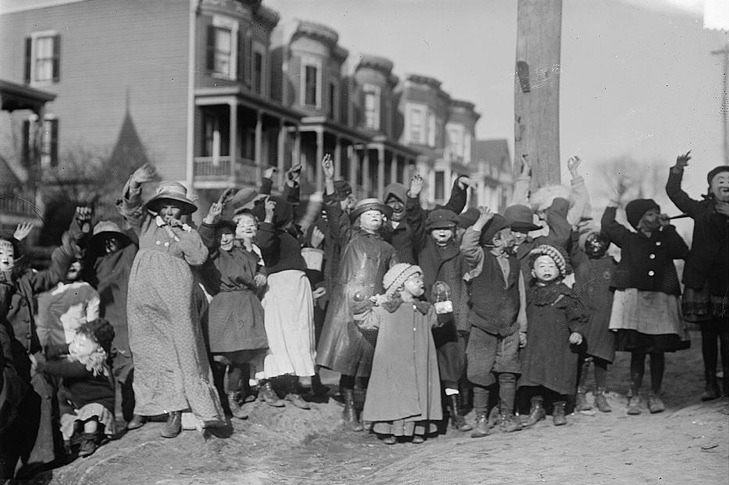
Source: Bain News Service

Noble includes this photo in her Author's Note. If you look closely, you'll notice that some of the kids are wearing masks. This was not uncommon, cheap masks were sold for the Ragamuffin Parade in candy stores. Because of that, the Ragamuffin Paraders are sometimes referred to as Thanksgiving Maskers, but the goal is the same - to beg for money (in fact, you might recall that the Ragamuffin Parade is mentioned in the book A Tree Grows in Brooklyn by Betty Smith:


"Most children brought up in Brooklyn before the First World War remember Thanksgiving Day there with a peculiar tenderness. It was the day children went around "ragamuffin" or "slamming gates," wearing costumes topped off by a penny mask."


You can find out more about the Ragamuffin Parade tradition HERE

Thirty Minutes Over Oregon: A Japanese Pilot's World War II Story by Marc Tyler Nobleman, illustrated by Melissa Iwai


I first heard about Thirty Minutes Over Oregon way back in 2011, when I did a post for Marc Tyler Nobleman about the possibility of getting it published. His post, Picture Book for Sale, is still online and quite interesting to read, in case you are interested.


Thirty Minutes Over Oregon begins September 1942, less than a year after the bombing of Pearl Harbor, when a Japanese pilot named Nobuo Fujita flew a small plane that had been catapulted from a submarine in the Pacific Ocean over to Oregon. The goal was to drop two 168 pound bombs into the Oregon woods to start a fire that would burn the woods and any nearby towns and cities. The mission was so hush-hush, not even Nobuo's wife could know about it. 


The bombs didn't start much of a fire, but imagine how the people in Brookings, Oregon felt when they realized that a Japanese plane has entered American airspace right over their heads. And twenty days later, Nobuo again flew into American airspace, in the same plane carrying two bombs. Though nothing came of this second attempt either, the Japanese still claimed victory.


The war ended in 1945 with the US bombing of Japan. Lucky for Nobuo who had been ordered to make a kamikaze attack on an American warship. Instead, he returned home and opened a hardware store.


Fast forward to 1962. The people of Brookings decided to track down and invite Nobuo Fujita as their Memorial Day guest of honor and thinking it would be a wonderful symbol of reconciliation between American and Japan. Not everyone in the US thought it was a good idea, but to everyone's surprise, Nobuo accepted the invitation, not without some fear and reservation, however. Was it a trick, would he be arrested and tried as a war criminal?


The 1962 visit showed the positive value of reaching out to a former enemy in peace. Nobuo was a friendly, respectful man, who had lived with the guilt of his attempted bombings of Brookings. His initial visit there began a lasting relationship between Nobuo and the people of Brookings, including an invitation extended to three high school students to visit Japan at his expense. Nobuo also donated large amounts of money for a town library for children's books. After he died in 1997, some of Nobuo's ashes were also scattered in the area where he had dropped his bombs.


As always, Nobleman has done his research on the only enemy bombing with the United States during WWII. And he has taken that research and written an compelling and emotional work of nonfiction. His text is simple and clear, and complimented by Melissa Iwai's beautifully rendered watercolor and mixed-media illustrations. Iwai has captured the gentle humanity of both the citizens of Brookings and of Nobuo and his family.


The message for us to take away from this little known WWII event and its aftermath is that a soldier is doing his job even if he is the enemy. What is important is how we reconcile after a war in order to heal and move on. That is the important legacy that Nobuo and the people of Brookings have demonstrated and that Nobleman has so poignantly captured in this picture book for older readers.


This book is recommended for readers age 7+

This book was borrowed from a friend

The Edelweiss Pirates by Jennifer Elvgren, illustrated by Daniela Stamatiadi


In a country where any form of resistance or rebellion against the repressive Nazi regime almost always meant certain death, most resisters and defiers went underground and worked from there. But one group that was more open in their defiance was the Edelweiss Pirates. This was loosely connected groups of youths throughout Germany who lived by their own moral code, refused to participate in the Hitler Youth, and continued to do things the way they wanted and that included swing dancing and listening to jazz, both of which were prohibited in Nazi Germany.


Now, Jennifer Elvgren, who wrote the excellent book The Whispering Town, has successfully captured the rebellion of the Edelweiss Pirates in her new book. Taking place in 1938, and told in the first person present, it is the story of Kurt, the younger brother of Albert, a member of the Pirates. Kurt desperately wants to be just like his brother and join him with his friends swing dancing, listening to and playing the music of great jazz artists like Louis Armstrong and Duke Ellington. But as Albert sneaks out one night, he tells Kurt that he's too young and it's too dangerous - they could be arrested. Instead, Albert gives Kurt a Louis Armstrong album.


That weekend, Kurt invites his Jewish friend Fritz to listen to the album with him. Fritz sneaks in through the same window Albert sneaks out of. The two boys are soon playing the music on the album by ear - Fritz on sax, Kurt on trumpet. At school, Kurt becomes more and more troubled as he sees anti-Semitic incidents directed at Fritz, but knows it is not the place challenge these acts. Instead he waits impatiently until he can be an Edelweiss Pirate like his brother - painting over swastikas and spreading around anti-Hitler leaflets.


Even after witnessing Fritz being forced to read a story to the whole class that says the Jews are their enemy, Kurt still does nothing to help his friend. Then, the school concert comes around, and the students are supposed to play music by Hitler's favorite composer, Richard Wagner. With his parents sitting in the audience, there to hear him play his trumpet, Kurt thinks of all the humiliations he has seen Fritz subjected to and before he knows it, he has finally finds a way to declare his defiance by loudly playing Louis Armstrong"s Saint Louis Blues instead, to the surprising accompaniment of Albert and the other Pirates, and even with some support from the audience, including his parents.


Such acts of open defiance were dealt with harshly, and Kurt is aware of that, but it was worth the risk. The next morning he discovers a note with an Edelweiss pin from his brother. Kurt is finally a Pirate, with the code name Blues.


The Edelweiss Pirates is indeed an interesting look at a group of resisters that most people have never really heard of, and although they didn't start out as saboteurs, by 1938, they were beginning to increase their subversive acts against the Nazis.


I liked that the story was told from Kurt's point of view. This coming of age story allows his frustration at not being able to protest the things he is seeing to grow until he must take a stand, even at the risk of severe punishment at school, and possibly at home. 


Stamatiadi's earth-toned illustrations are simple, but never let the reader forget that they are reading a book that is set in Nazi Germany by including the symbols of that regime throughout, including the required picture of Hitler in the classroom.


At a time when most people were afraid to speak out against the injustices and cruelties they were witnessing on a daily basis, Kurt is an inspiring character, finding his voice and means to protest. This is indeed a picture book for older readers that should resonate with strongly with them even today.


Be sure to read the Author's Note at the back of the book to learn more about the history of the Edelweiss Pirates. You'll also see that there aren't any recommendations for age appropriate further reading on this topic because there simply wasn't anything until The Edelweiss Pirates was published.


This book is recommended for readers age 8+

This book was obtained from the author at BookExpo


Fania's Heart by Anne Renaud, illustrated by Richard Rudnicki


Back in 2015, I reviewed a book for teens called Paper Hearts by Meg Wiviott. A novel in verse, it told the story of two young Polish women, Zlaka and Fania, who were slave laborers in Auschwitz in 1944. At the center of the novel is a small heart, crafted by Zlatka for Fania's 20th birthday, and signed by all of the 19 girls that Fania worked with.


Now, this inspiring story has been is retold in a picture book for older readers by Anne Renaud. Fania had survived Auschwitz, and traveled to Canada after the war, married and had a daughter named Sorale, nicknamed Sandy. As a young child, Sandy understood that her mother had many secrets, among them were why she had no relatives - no mother, father, siblings, cousins. aunts or uncles, and why there was a tattooed number on her arm.


Then, one day, when Sandy was 10, she came across another of her mother's secrets. It was a tiny book shaped heart, with a purple cloth cover and the letter F embroidered in orange thread. Opening it up, she saw lots of words in different languages, but could only read a few names. Her mother finally told her daughter her secrets when Sandy asked her about the heart.


Fania begins with her imprisonment in Auschwitz, after being torn from her home and family because Hitler hated certain people, but especially Jews. In Auschwitz, she was no longer a human being but became a number - 74207.  She describes the deplorable conditions she and everyone else in Hitler's concentration camps were forced to live under, how she and the other girls in her barrack worked as slave laborers in a munitions factory making weapons for the German army, and how they tried to sabotage the what they made whenever they could, and then, how they were forced to walk a mile to and from the their job in all kinds of weather. All the while, Fania searched for her family among the other prisoners, but never saw them.


Although they lived in constant fear and extreme hunger, Fania and her friends would recall recipes and food they loved. One day, Fania mentioned she was going to turn 20 soon. Imagine her surprise when she was secretly handed a small handmade heart-shaped card from her friends on her birthday. The heart was a cherished bit of hope and resilience for Fania: "It is an act of defiance. A symbol of strength. An expression of hope and love. My friends wanted to prove that despite all that was inflicted upon us, we could still treat each other with humanity. Their words saved me."


The heart is also the only tangible thing Fania had left from her past.


Fania's Heart is a very moving story. It is historical fiction based on the true experiences of Fania Fanier, née Landau. This is such a well written, poignant story of resistance and survival under such  unimaginable circumstances. It begins from the point of view of her daughter Sandy, but seamlessly switches to Fania's voice, always shown in quotes. To her credit, Renaud has managed to describe the horrors of living in a concentration camp under the Nazis including enough reality without getting overly graphic, given he age of her target audience.


There is an interesting Author's Note at the end of the book that briefly describes how Hitler and the Nazis believed in the racial inferiority of certain groups of people, including Jews. It goes on to describe how Fania's heart was made and hidden from the Nazis. The heart was eventually donated to the Montreal Holocaust Museum, where it is on display.


I thought that Rudnicki's realistic watecolor illustrations captured so much truth about the harsh conditions in Auschwitz, but also the intensity of the friendships the girls developed with each other. The post-Auschwitz illustrations have a bit more clarity to them than the ones that involve Fania and her friends during the Holocaust, giving them  a real sense of being a focused part of Fania's memory.


While this is an excellent telling of Fania's important story, I do wish there had been more back matter, such as a more detailed biography of Fania's life before and after the war, and a list of suggestions for further reading. For this reason, it book felt incomplete to me.


This book is recommended for readers age 7+

This book was borrowed from the NYPL


So, who was Fania before she became 74207? Fania was born on December 12, 1924 in Bialystok, Poland. According to the Museum's website, she ended up in Auschwitz after a boy in Bailystok pointed to her and yelled "Jew!" Fania wasn't wearing the required yellow star and was immediately arrested. She never saw her parents, her brother Leybl, or sister Moushka again. Fania found herself first in Stutthof Concentration Camp doing forced labor. In 1943, she was transferred to Auschwitz-Birkenau, where she was put to work in the munitions factory there. In 1945, as the Russians advanced towards Auschwitz, the Nazis decided to evacuate Auschwitz in an attempt to hide their crimes there, and Fania was part of a forced death march of prisoners. She survived the march and was deported to Ravensbrück Concentration Camp. Once again, she survived and after the war, she moved to Toronto, Canada.


If you are wondering how such an elaborate heart could be made under such stringent conditions, you might want listen to the creator of the heart, Zlatka Pitluk (née Snajderhauz). It's in German or Yiddish, but there are subtitles:


Write to Me: Letters from Japanese American Children to the Librarian They Left Behind by Cynthia Grady, illustrated by Amiko Hirao


After the bombing of Pearl Harbor and the entry of the United States into WWII, this country, the country that was fighting for freedom and democracy aboard, did a terrible thing to some of its citizens. It began when President Franklin D. Roosevelt signed Executive Order 9066 on February 19, 1942, an order that authorized the internment of over 100,000 Japanese American citizens, including men, women, and children, as well as any resident aliens from Japan.


Write to Me is the story of one San Diego librarian, Clara Breed, who saw the injustice of incarcerating innocent people and whole families and tried to make it somewhat bearable for her young library patrons. Grady begins with the sad moment when young Katherine Tasaki has to return her books and relinquish her library card. Later, seeing the children she knew from the library off at the train station, Miss Breed gave out books and stamped postcards for the kids to write and let her know how and where they are and if they needed anything.


Soon, the postcards Miss Breed had give out began to arrive at the library from [Santa Anita Racetrack] Arcadia, California. She began writing the kids, sending them boxes of books and more postcards. The one time she visited Santa Anita, she brought even more books. After seeing the kinds of circumstances her young friends were being subjected to and the enjoyment the books she sent gave them, Miss Breed began writing letters and magazine articles asking for libraries to be opened in the internment camps for the kids to have easier access to reading.


Miss Breed continued to correspond with the kids she knew even after they were moved to the Poston Internment Camp in Poston, Arizona, in the middle of the desert. She also continued sending books, as well seeds, thread, soap, and crafts materials. Learning about the harsh desert conditions they lived with everyday, Miss Breed continued to write letters and magazine articles, hoping to make the country aware of how its citizens were being treated.


Write to Me is a picture book for older readers who are just beginning to learn about this period of American history and while it focused on Miss Breed's actions more than on the actual treatment of the Japanese American families she tried to help or the pervasive racism towards them, it does show young readers that one person can really make a difference in the lives of others. I think that's a message that will certainly resonate for them in today's world.


Interestingly, the focus of each of Amiko Hirao's gently muted color pencil illustrations is reflected in the postcard excerpts sent by the children that are found on almost every page.


There is extensive back matter, including an Author's Note, a recounting of Notable Dates in Clara Breed's Life, Selected History of Japanese People in the United States, a Selected Bibliography, and suggestions for Further Reading. The front and back end papers contain relevant captioned photographs.


Though it is for a somewhat older child, with scaffolding teachers might want to pair this with I Am An American by Jerry Stanly, for a more rounded picture of Japanese American internment camps.


The Japanese American National Museum has an online collection of letters written to Clara Breed from her young patrons incarcerated in internment camps, including Katherine Tasaki. You can read them HERE


One of the magazines Clara Breed wrote articles for was the Horn Book Magazine and you can read one of her articles "American with the Wrong Ancestors" published July 7, 1943 HERE


This book is recommended for readers age 6+

This book was purchased for my personal library


Clara Breed wrote another article in Jan/Feb 1945 issue of the Horn Book Magazine, which is not online but I found it in the library. The article is "Books That Build Better Racial Attitudes" and while it is really dated, I was curious to see what she recommended. One of the books is called The Moved-Outers by Florence C. Means, about the internment of a Japanese American family, and may very possibly be the first book about it. It was also a 1946 Newbery Honor book. I actually read it when I was researching my dissertation, but ultimately didn't use it, except as an example of patriotic propaganda. I'm definitely going to have to reread it one of these days.

Chester Nez and the Unbreakable Code: A Navajo Code Talker's Story by Joseph Bruchac, pictures by Liz Amini-Holmes


In 1929, when he was only 8 years old, Betoli was removed from his Native family and sent to the Navajo boarding school at Fort Defiance, Arizona, the very same place where Navajos had been held captive in the 1860s by the United States Army, after a forced long walk of 300 miles. At Fort Defiance, Betoli had his long, black hair cut short, was given the English name Chester, and forbidden to speak his native Navajo language. If children were caught speaking Navajo, their mouth would be washed out with yellow soap by a matron.


Every year, Chester returned to his family during the summer and kept his native ways. Then, in 1941, when he was in tenth grade, the United States entered World War II. In 1942, the US Marine Corps visited the Reservation. They wanted men who could speak English and Navajo to develop a code for sending messages that the Japanese codebreakers couldn't figure out. Initially, only 29 Navajos, including Chester, were chosen out of the many who volunteered, forming Platoon 382.


Slowly and methodically, they first developed an alphabet, then a vocabulary of words that wouldn't have to be spelled out each time they were used. So for example, the Navajo word for whale (lo-tso) became the code word for battleship. Once a complete code was developed, it was time to test it out on the battlefield. Chester and the other Navajo code talkers in Platoon 382 were sent to the Pacific Theater, where the code they created helped to finally defeat the Japanese.


Chester returned home after the war, but it had left its mark on him. His family arranged a four day long Enemy Way ceremony to help restore him to the "trail of beauty and the Right Way" so he would not have nightmares about war anymore.


Chester Nez and the Unbreakable Code is both a wonderful introduction for young readers about the history of the code talkers and of one man's strong determination to maintain his connection to his Navajo heritage no matter what. Bruchac is very familiar with this topic, having previously published a middle grade novel about the code talkers. However, he has successfully synthesized the information about Chester Nez's experience as a Navajo child and man with the history of the Navajo code.


According to the Author's Note, the hundreds of Native American who were code talkers were told to keep their work secret, even from their families, until 1968, when it was declassified and they could finally talk about the important contribution they had made during the war. But it wasn't until December 2000, when the Honoring the Navajo Code Talkers Act was enacted, that they were finally honored and awarded the medals they so rightly deserved.


Liz Amini-Holmes soft-focused, richly textured illustrations are painted in a palette of mainly yellows, blues, and greens that do much to capture the relationship Nez had with his Navajo culture and home, and the pain and loneliness  of being taken away to boarding school and later of fighting in the war. They are almost expressionistic in the way they express the emotions Chester must have felt rather than merely depicting the external events he lived through.


Besides the Author's Note, the back matter also includes some of The Navajo Code and a timeline of Chester Nez's life.


Bruchac begins each section of Chester's story with the month and year in which something occurred followed by an unfamiliar description, for example. October 1929: Month of Small Wind or September 1942: Month of Half. At first, I thought perhaps the descriptions were part of the Navajo lunar calendar, but it turns out to be the names of the month in Navajo code. That made me understand even more clearly just why the Japanese were unable to break it.


I highly recommend this picture book for older readers who might be interested in WWII and/or Navajo history.


This book is recommended for readers age 7+

This book was borrowed from the NYPL


The Promise by Pnina Bat Zvi and Margie Wolfe, illustrated by Isabella Cardinal


On the night that the Nazis took all the adults in their town away, sisters Rachel and Toby are separated from their parents but not before they are given a shoe paste tin with three gold coins in it. Not knowing what is going to happen to them, they are told to use the coins only if they have to, that they would know when the time was right. And most importantly, they must promise to try to always stay together.


Two years later, the sisters are now in Barrack 25 in Auschwitz, along with many other Jewish girls. Every other day, the girls build a wall of heavy fieldstone, and then, they tear it down only to begin again. When a girl gets sick, she is taken to the hospital and never seen again. Everyone in the barrack knows what has happened to her and do their best not to get sick, despite insufficient clothing, food, and bedding in bad weather.


When Rachel becomes ill, there is nothing Toby can do to prevent her from being taken to the hospital while she is working. Discovering Rachel gone when she returns, Toby knows she needs to do something quickly, or she will never see her sister again. Is this the right time to use the gold coins her parents gave them?


Using her wits, some clever planning, some luck, and the gold coins, Toby manages to get Rachel out of the hospital and back to the barrack. But the next day at roll call, she pays dearly for what she has done when the guard sees Rachel on line but not in her roll book. The guard whips Toby on her back with the leash of her dog, but she didn't send Rachel back to the hospital. Both sisters survive the war and walk out of Auschwitz together.


The Promise is a compelling and inspirational picture book for older readers about the importance of keeping promises, of family, and of the strength of sisterly love, particularly under the kinds of circumstances Toby and Rachel found themselves in trying to survive Auschwitz. And although it is a fictionalized biography, it is based on the real life experiences of sisters Toby, mother of author Margie Wolfe, and Rachel, mother of author Pnina Bat Zvi.


Photos of Toby and Rachel

The illustrations by Isabella Cardinal are done in a mixed-media of collage and photos together with textural drawings and finished in Photoshop, and really capture the emotions that sisters were feeling, and the anger and hate the guards had for them. The Holocaust was a very dark time in history and the illustrations aptly reflect that.


Holocaust picture books are always a difficult subject for young readers - how much graphic description to include. If too much is included there's the risk that the young reader will be so traumatized by what they read, that they never want to read about the Holocaust again. And although Toby and Rachel, like everyone in a Nazi concentration camp, faced beatings, brutality, starvation, and death everyday, Wolfe and her cousin Bat Zvi have managed to find a balance between the mistreatment and the love and resilience that kept these two sisters fighting for their lives.


The Promise is an important addition to the literature of the Holocaust, especially as it recedes into history. Keeping the Shoah alive by remembering it is so important now.


This book is recommended for readers age 8+

This book was an EARC received from NetGalley


You can read in interesting interview with authors Margie Wolfe and Pnina Bat Zvi and illustrator Isabella Cardinal HERE

The Christmas Truce of 1914 - a picture book roundup

(This post gets filed under the rubric Better Late Than Never. My Kiddo arrived home at 2:00 AM Christmas morning, we've been catching up, and I forgot to set this up to publish automatically.)


The story of the Christmas Truce of 1914 is an interesting one. The very fact that ordinary soldiers fraternized with each other on the battlefield, even for one day, was considered to be an act of treason by both the British and German governments. But when you realize that war is a political act, and soldiers are the powerless who must carry out the commands of their superior officers unquestioningly, the story about Christmas Truce becomes all the more meaningful. In his Author’s Note to Shooting at the Stars, John Hendrix writes that the truce “stands as a lasting example of ordinary men doing the extraordinary…Armed with carols and Christmas trees, individual men threw away their weapons and walked toward the enemy with a desperate hunger for peace.” I think that the hunger for peace is a true today and it was in 1914.


The Best Christmas Present in the World by Michael Morpurgo, illustrated by Michael Foreman


2004, 2014, Egmont UK, 48 pages, age 7+


Accompanied by Michael Foreman’s beautiful, touching illustrations, in this short story turned picture book, the past and present meet in the form of a letter. It begins in the present day with a purchase of a much desired roll-top desk in need of restoring due to fire damage. The unnamed narrator decides to begin work on it on Christmas Eve to escape overly excited relatives for a while. Pulling out the drawers, he discovers a letter written on December 26, 1914 and addressed to Mrs. Jim Macpherson. In the letter, a soldier describes how British and German soldiers came together on that frosty Christmas morning, sharing food and drink from each other’s Christmas packages, and playing a game of football. For Captain Jim Macpherson, the day was spent getting to know Hans Wolf from Dusseldorf, who spoke perfect English and whose favorite book was Thomas Hardy’s Far from the Madding Crowd. At the end of the day, the two parted friends. On Christmas day, our narrator decides to visit the address on the letter, an old house that had had a fire. A neighbor tells him the woman, Mrs. Macpherson, now about 101 years old, had survived and was in a nursing home, where the narrator next goes. Yes, he finds her, she recognizes the letter, but the ending though sad, it so poignant. But, you can read it for yourself. The story was published in the Guardian in 2003 and you can find it here:


Shooting at the Stars: The Christmas Truce of 1914 by written and illustrated John Hendrix


2014, Abrams BFYR, 40 pages, age 7+


After a short introduction about World War I, Hendrix begins his story with a young freckle-face soldier named Charlie writing a letter home to his mother from France, and telling her about the cold, wet, muddy experience of living in trenches with rats vying for their rations of cold beans, all nicely captured in an accompanying illustration. Since Christmas has arrived, hope that the war will end by then has faded, but, he writes, something extraordinary does happen. German soldiers begin singing Silent Night and all along their trench line little lit up Christmas trees appear. In the morning, British and German soldiers meet on the battlefield, shake hands and begin helping each other bury their dead soldiers. Pictures are taken, uniform buttons exchanged, food shared, and football played, and the inevitable question of soldiers was asked: why can’t we just have peace. And the answer comes from Charlie’s superior Major Walter Watts who orders them back to their trenches and to being fighting again. Their splendid day over, Charlie writes his mother that he suspects they will spend the rest of the night shooting at the stars instead of their enemy. Hendrix did the illustrations for this story in an acrylic wash of blues, yellows and greens, reflecting the cold landscape and the warmth of the men meeting momentarily as friends on No Man’s Land.


The Christmas Truce: The Place Where Peace Was Found by Hilary Robinson, illustrated by Martin Impey


2014, Strauss House Productions, 36 pages, age 7+


The moon is shining brightly on Christmas Eve, 1914, when Christmas lights appear atop the German trenches and two German soldiers, Karl and Lars, begin to sing Sille Nacht on one side of No Man’s Land. They are soon answered by Ray and Ben, best friends and British soldiers on the other side, singing Silent Night. Slowly the two armies, enemies the day before, leave the trenches, meet on the battlefield, and shake hands as church bells are heard chiming. Pretty soon, a soccer ball is brought out and a friendly Christmas morning game is played. The soldiers are sure that their example of peace on earth, goodwill towards all will end the war soon, but that was not to be. This is a poignant retelling of the Christmas Truce story, a cumulative tale where the rhyme repeats and builds up using the previous lines as the story moves forward (think This is the House that Jack Built), and each final line reminds us that No Man’s Land, in the midst of war, was a place where peace was found, if only for one day and night. Along with the text, the illustrations, set in a palette of wintery blues, capture this unusual pause in the fighting - the barbed wire, the youthfulness of the soldiers, a debris strewn No Man’s Land. Though the faces of the soldiers are a bit playful, they carry a definite feeling of grace to this most graceful of moments. 


And the Soldiers Sang by J. Patrick Lewis, illustrated by Gary Kelley


2011, 2014 Creative Paperbacks, 32 pages, age 8+


Answering the King’s call for men to enlist once war is declared in 1914, a young unnamed Welshman from Cardiff joins the British army, and chronicles his experiences in a journal his father's give him. He begins with crossing the English Channel in September, riding in a cattle car crammed with soldiers from France to the Western Front in Belgium. Fighting the Germans across no man’s land, the weather gets colder and wetter, the trenches are filled with water and rats, the noise of machine gun fire is deafening, and the young Welshman suffers from with the agony of trench foot. But then, on Christmas Eve, lights on trees are seen across a No Man’s Land, littered with debris and dead soldiers, and suddenly a German soldier begins to sing Stille Nacht and is answered by the young Welshman singing First Noel. And so the Christmas Truce of 1914 begins. Soldiers on both sides meet, help bury the dead, share food and photographs of family, and the young Welshman is convinced that the war will end soon, how could it not after what he just experienced, and what a story to tell his grandchildren, but alas, that is not to be. The British Major orders that soldiers back into the trenches and the war continued. It was Lewis’s hope that readers would see “the helplessness of war, the futility of it’ and that in war, it is always the soldier, on the front lines, who pays the price of fighting. This is an incredible book - emotional, moving, frustrating, and ultimately almost devastating, but a tale that could easily reverberate in today’s world. The illustrations are dark, in a palette of browns and blacks, reflecting the utter grimness of war. This is not a happy Christmas Truce story, but one that will definitely impact readers.


I've already reviewed two excellent books about the Christmas Eve Truce of 1914 which you may be interested in reading about:


Truce: The Day the Soldiers Stopped Fighting by Jim Murphy is the first truce story I read.  Murphy's excellent nonfiction account gives a history leading up to the start of World War I, what life in the trenches was like and, of course, the Christmas truce.


Christmas Truce by Arron Shepard is the second truce story I read.  This is a fictional account of the Christmas Eve truce told by a soldier in a letter home to his sister.  There been some false beliefs and misconceptions surrounding this night when fighting ceased and goodwill took over.


There are countless articles about the real Christmas Truce of 1914. Here is one I recommend: